Jidai Matsuri Costumes: 8 Eras of Kyoto's Festival of the Ages Explained
·
 Written by Mei · IKOKA Japan
Jidai Matsuri costumes explained: the story behind the 8 eras in Kyoto's Festival of the Ages, from Meiji to Enryaku, and what to spot as each era passes.

You're on the curb for Kyoto's Festival of the Ages, the biggest Kyoto October festival, and you have no idea who's who in the parade. Noon on October 22, outside the Kyoto Imperial Palace. The first group to march out, to the sound of fifes and drums, isn't samurai at all but a volunteer militia from the Meiji Restoration. Then, as the roughly 2-kilometer parade unfolds, time runs backwards, until the very end brings officials from the Enryaku era (782–806), when Heian-kyo, today's Kyoto, was built.
The Jidai Matsuri is a thousand years of Kyoto told through clothing. Here is where those costumes come from, and what to look for as each era walks past. Information rechecked against official sources on October 31, 2026.
At a glance
- Held every year on October 22; postponed if it rains
- About 2,000 people in about 20 groups, with about 70 horses and oxen, stretching about 2 km
- About 12,000 costumes and ceremonial items, recreated through strict historical research
The 8 eras of the Jidai Matsuri, in parade order
The procession starts with the Meiji Restoration and travels back through eight eras to the Enryaku period.
| Order | Era | Years | Look for |
|---|---|---|---|
| 1 | Meiji Restoration | 1868 | The fife-and-drum Ishin Kinnotai corps |
| 2 | Edo | 1603–1868 | Footmen tossing spears and boxes; Princess Kazunomiya, Izumo no Okuni |
| 3 | Azuchi-Momoyama | 1568–1603 | Toyotomi Hideyoshi's ox carriage; Oda Nobunaga |
| 4 | Muromachi | 1338–1573 | The Ashikaga shogunate; Furyu-odori dancers |
| 5 | Yoshino | 1333–1392 | Kusunoki Masashige's ornate armor |
| 6 | Kamakura | 1192–1333 | Mounted archers in deerskin |
| 7 | Fujiwara | 897–1185 | Court nobles; women of the Heian period |
| 8 | Enryaku | 782–806 | Sakanoue no Tamuramaro; officials in rank colors |
The table is based on Heian Jingu's procession guide and the Kyoto City Tourism Association; era years follow the Kyoto City Tourism Association.
Festival of the Ages, Kyoto: why the parade walks backwards in time

The festival began in 1895 (Meiji 28) to celebrate the founding of Heian Jingu Shrine and the 1,100th anniversary of the capital's move to Heian-kyo. It was part of an effort to revive Kyoto, which had declined sharply after the Meiji Restoration. The first procession was held on October 25; from 1896 it moved to October 22, the anniversary of the capital's founding.
The parade is run by the Heian Kosha, a citywide civic organization of 11 member groups. It began with 6 groups and 500 people; today the 8 eras are split into 20 processions. The people wearing these costumes are Kyoto residents, and that is the real charm of the day.
Meiji and Edo: fifes, drums and the "hii-saa" call
The lead Ishin Kinnotai recreates the Yamaguni-tai, a corps formed by villagers from Yamaguni in Tanba during the Meiji Restoration. Their haori jackets, hakama, headbands or red-fur headgear, straw sandals, swords and rifles, plus shoulder marks showing rank, capture the shift toward a modern army.
In the Edo section, listen. The footmen carrying spears, umbrellas and boxes shout "hii-saa" as they march, a call that echoes the period. The Edo women's procession follows, including Princess Kazunomiya dressed as a court lady at about 16, and Izumo no Okuni, who danced on the riverbank at Shijo and is credited as the founder of kabuki.
Women of the Middle Ages: the Oharame and their firewood

The medieval women's procession includes not just famous figures but working women. The Oharame from Ohara, north of Kyoto, carried firewood and charcoal on their heads to sell in the city; the parade shows their late-Muromachi look. The Katsurame, who sold sweetfish and candy from the Katsura River, wear short kimono with hair wrapped in white cloth.
The same line includes Yodogimi in lavish Momoyama-era outing clothes and Shizuka Gozen dressed as a shirabyoshi dancer. Women of very different rank and trade walk side by side.
Muromachi Furyu-odori: the ancestor of Bon dancing

The second half of the Muromachi section recreates Furyu-odori, a dance that wealthy Kyoto townspeople staged in the 16th century. A large decorated umbrella sits at the center, with musicians inside the circle and dancers around them. At the time only men danced, in eccentric costumes or flashy women's clothing. The dance spread across Japan and became the prototype of Bon dancing from the Edo period on.
Heian women and officials: layered robes and colors of rank
The Fujiwara-era clothing reflects the time when Chinese influence faded and a distinctly Japanese court style took shape. In the Heian women's procession, Sei Shonagon, author of The Pillow Book, wears full formal court dress with karaginu jacket and mo train (the "twelve layers" style), while Murasaki Shikibu, author of The Tale of Genji, wears the less formal kouchigi. Two great writers, one formal, one casual: it is fun to compare.
At the very end, the Enryaku civil officials wear robes whose color was fixed by rank: light purple for the third rank, deep scarlet for the fourth, light scarlet for the fifth, deep green for the sixth. Coming just after the capital moved, these outfits still carry Nara-period rules and a strong Tang Chinese style. The Enryaku military officials' procession, led by Sakanoue no Tamuramaro, is the one rebuilt from Shosoin treasures and tomb finds, since sources for this era are scarce.
The real stars: two emperors' sacred palanquins

Every group in this long parade is, in fact, an escort. The heart of the Jidai Matsuri is carrying the spirits of Emperor Kanmu and Emperor Komei, the deities of Heian Jingu, through Kyoto in sacred palanquins (gohoren) so they can look upon the lives of its people. The front palanquin carries Emperor Komei and the rear one Emperor Kanmu. Behind them come the Shirakawame, women who carry flowers on their heads as offerings.
Where to see it: the October 22 parade and Heian Jingu

The parade leaves the Kyoto Imperial Palace at 12:00, the front reaches Heian Jingu around 14:30, and the whole line takes about 2 hours to pass any one spot. Once every group has arrived, the day closes at 16:00 at the Daigokuden, where the third-rank official of the Enryaku procession reads the ritual address. Corner-by-corner times, seat availability, rain plans and how to get home when the crowds leave Heian Jingu are all in our day-of guide.

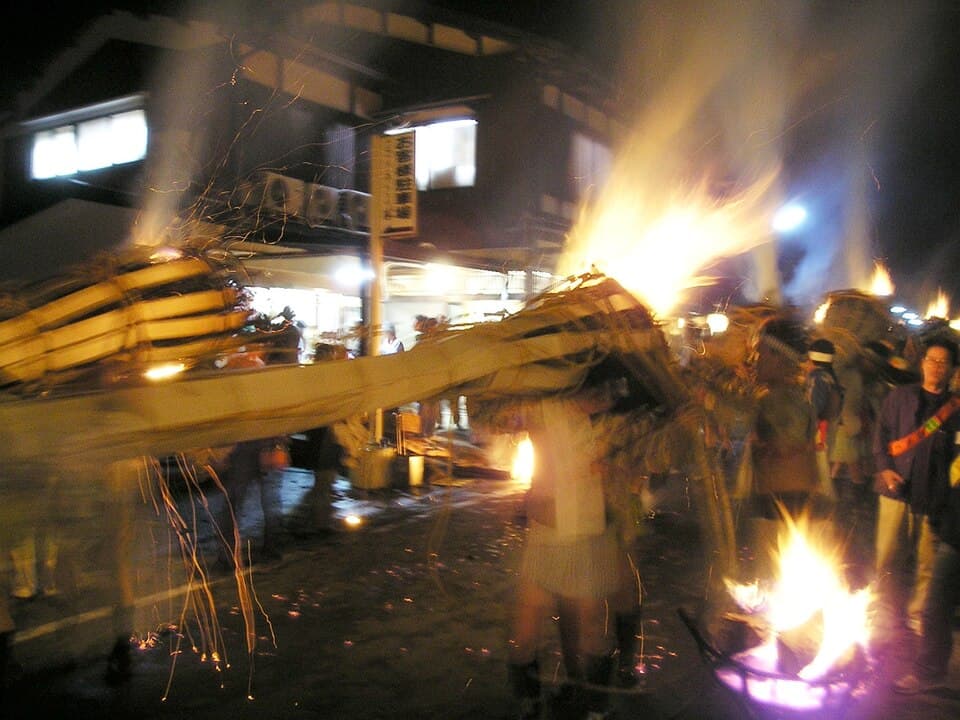
The same night, the Kurama Fire Festival lights up the north of Kyoto: costumes by day, torches by night. Here is the story behind those torches, and the practical guide for getting there.

For more autumn and winter festivals without the crush, see our free guide.
Check the day-of guide for your corner's time, then tell us: which era will you stop and wait for?
Sources
Facts in this article were checked against these official sources.
Photo credits
Comments
Anyone can comment with just a nickname. Comments with links or contact details are published after review.
Loading comments…