Karatsu Kunchi Hikiyama Floats: The Stories Behind All 14
 Written by Mei · IKOKA Japan
Karatsu Kunchi floats explained: all 14 lacquered hikiyama, from the 1819 Red Lion to the Seven Treasures Ship, how they are made and where to see them.

Picture a red lion head taller than the shop roofs, swaying toward you while hundreds of haulers shout "Enya, enya!" That lion has been doing this since 1819, and 13 more floats followed it. This is the story of the Karatsu Kunchi hikiyama: what each of the 14 floats is, when it was made, and why a small castle town in Saga built them.
Karatsu Kunchi is the autumn grand festival of Karatsu Shrine, held every year from November 2 to 4. The floats are the reason people come.
At a glance
- 14 floats from 14 districts, built between 1819 and 1876.
- Made from layered washi paper and lacquer, among the largest dry-lacquer artworks in the world.
- A national Important Intangible Folk Cultural Property, and part of UNESCO's "Yama, Hoko, Yatai" float festivals.
Karatsu Kunchi hikiyama origin: from shouldered floats to a lacquered lion
Before today's giants, each district carried a shouldered float called a katsugi-yama. Later came hashiri-yama, wheeled carts topped with each district's own decorations, pulled around with force.

Then, in 1819, Katana-machi finished the Red Lion (Akajishi): a giant lacquered lion head with musicians riding inside its cart. The other districts were amazed, and they kept building new floats until 1876. Its maker, Ishizaki Kahei, is said to have been inspired by the Gion Festival floats he saw in Kyoto on his way home from Ise. On November 3 the Red Lion alone carries a sacred paper wand (gohei) behind its horn, a custom no other float has.
How a hikiyama is made: 200 sheets of paper and lacquer
A hikiyama is not carved wood. Builders shape a clay mold on a wooden frame, paste 100 to 200 sheets of washi on it until the layer is 1 to 3 cm thick, remove the mold, harden the shell with hemp cloth and lacquer, and finish it with colored lacquer and gold leaf. Each body rides on a four-wheeled wooden cart held up by one central pillar; the turtle and the two ships need two. One float took 3 to 6 years to make.
All 14 Karatsu Kunchi floats in order
| No. | Float | District | Made |
|---|---|---|---|
| 1 | Akajishi (Red Lion) | Katana-machi | 1819 |
| 2 | Aojishi (Blue Lion) | Naka-machi | 1824 |
| 3 | Turtle and Urashima Taro | Zaimoku-machi | 1841 |
| 4 | Helmet of Minamoto no Yoshitsune | Gofuku-machi | 1844 |
| 5 | Tai (Sea Bream) | Uoya-machi | 1845 |
| 6 | Hoomaru (Phoenix Ship) | Oishi-machi | 1846 |
| 7 | Hiryu (Flying Dragon) | Shin-machi | 1846 |
| 8 | Kinjishi (Golden Lion) | Hon-machi | 1847 |
| 9 | Helmet of Takeda Shingen | Kiwata-machi | 1864 |
| 10 | Helmet of Uesugi Kenshin | Hirano-machi | 1869 |
| 11 | Shuten-doji and the Helmet of Minamoto no Raiko | Komeya-machi | 1869 |
| 12 | Tamatori Jishi (Lion with a Ball) | Kyo-machi | 1875 |
| 13 | Shachi | Kako-machi | 1876 |
| 14 | Shichihomaru (Seven Treasures Ship) | Egawa-machi | 1876 |
The floats always appear in this order, so the number tells you what is coming next.
The lion family: red, blue, gold and a lion on a ball

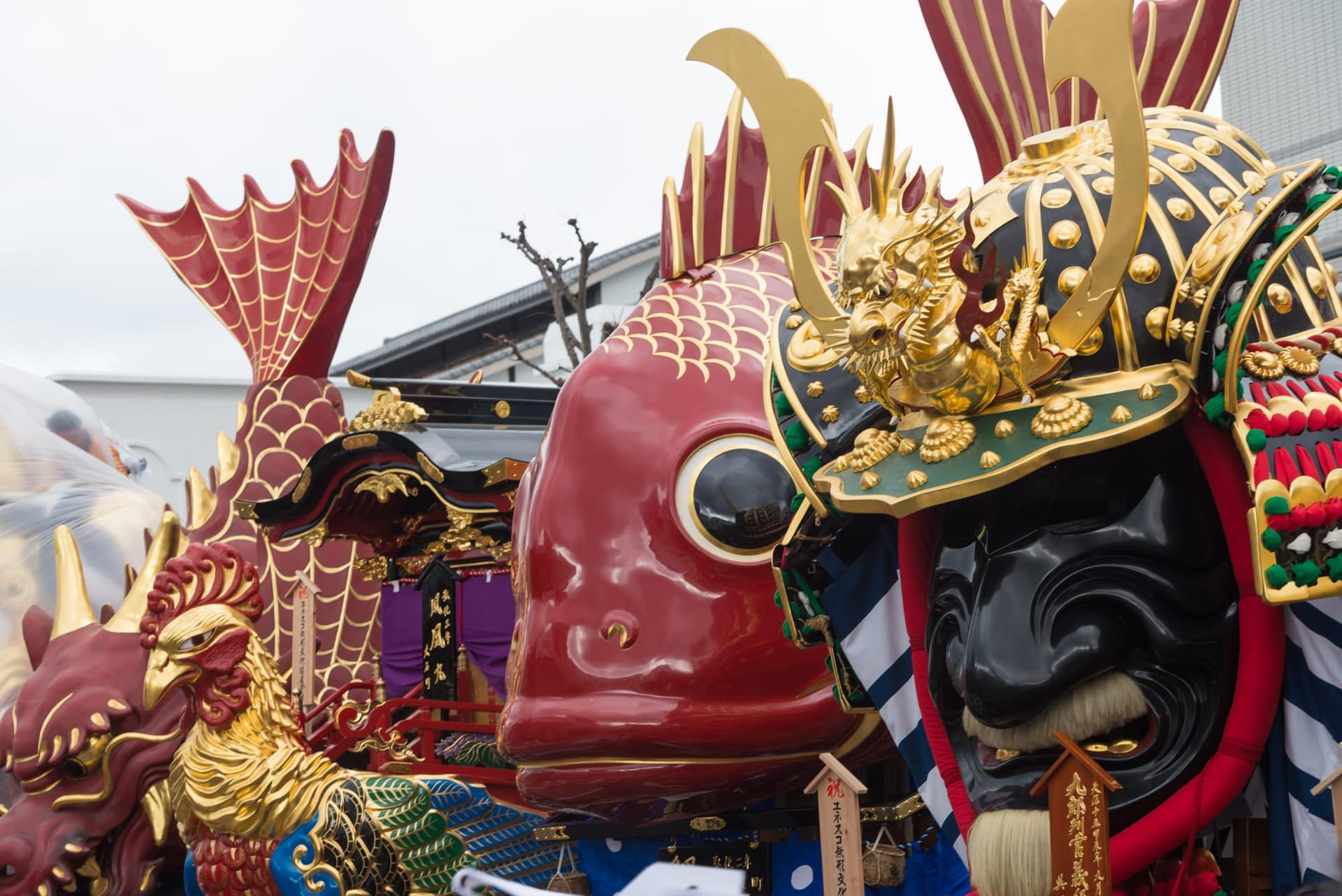
Four of the floats are lions, and each has its own face. The Blue Lion, made 5 years after the Red Lion, is painted green with a forked horn, and its bared teeth make it look fiercer than its gentle red elder. The Golden Lion is covered in gold and measures 3.2 m wide and 2.6 m deep, the biggest lion head of all and thought to be the largest in Japan. The Tamatori Jishi grips a red ball with all four legs, which is rare; most lions of this type hold the ball with one paw.
Samurai helmets: four floats, four warriors

The Yoshitsune helmet was the first helmet float, copied closely from a real helmet and scaled up. Three more followed: Takeda Shingen's helmet with its deer antlers, Uesugi Kenshin's helmet with three sparrows on the visor, and the most dramatic one, where the severed head of the demon chief Shuten-doji bites the helmet of Minamoto no Raiko. Look at the helmets from the side: the visors and neck guards are where the detail is.
Creatures of the sea: sea bream, turtle and shachi

The Sea Bream is lacquered vermilion with black eyes, and the fish-sellers' district is said to have chosen it as the best of fish or as an offering to the gods. On the turtle float, Urashima Taro sits on the shell with a fishing rod in one hand and a treasure box in the other. The Shachi has a fish body and a tiger head; shachi are said to spout water to protect buildings from fire, and this one can move its head and tail up and down.
Ships and a dragon: the heaviest floats

The Phoenix Ship is built with wooden molds and frames instead of paper, which makes it especially heavy, so it rests on two posts. The Seven Treasures Ship has a dragon head at its bow and carries seven lucky objects, including a wish-granting jewel, a war fan and a magic mallet. The Flying Dragon has huge wings and a big tail but only two front legs.
On November 3 the floats escort the portable shrine to Nishinohama, where floats of 2 to 3 tonnes sink into the sand and the chanting reaches its peak. For the full day-by-day timetable, see our festival guide below.

The sound that tells you which float is coming
The float music is played aboard with flute, bell and drum, and it is one of the 100 Soundscapes of Japan. There are three tunes. Michi-bayashi is a quiet, court-style tune that only the Red Lion plays, from Karatsu Shrine to Oteguchi when it sets off on November 3. Seri-bayashi comes with the "Enya, enya" and "Yoisa, yoisa" chants, and each district plays it so differently that locals can name the float by sound alone. Tateyama-bayashi plays while the floats rest; one theory links it to stone-hauling songs from the building of Hizen Nagoya Castle.
Why the floats matter: from a town treasure to UNESCO
The floats were named a Saga Prefecture cultural property in 1958, and the hikiyama event became a national Important Intangible Folk Cultural Property in 1980. In December 2016 it was inscribed by UNESCO as one of 33 Yama, Hoko, Yatai float festivals in Japan.
Where to see the hikiyama outside the festival

You do not have to come in November. The Hikiyama Exhibition Hall stands next to Karatsu Station in the grounds of Karatsu Furusato Kaikan Arpino. It is open 9:00 to 17:00 (closed December 29 to 31), and entry is 310 yen for adults and 150 yen for elementary and junior high students. On April 29, at the shrine's spring festival, the floats line up in front of Karatsu Shrine from 10:00 to 15:00, unless it rains.
Information rechecked on November 4, 2026, on the official Karatsu City pages.
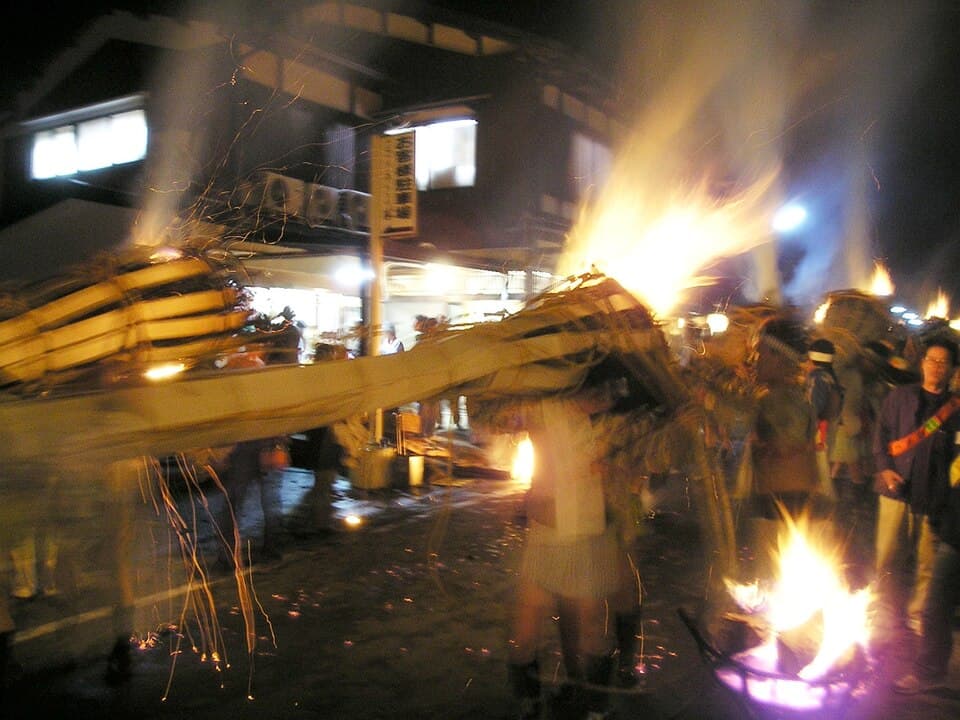
If floats with stories behind them are your thing, Kyoto's torch festival has one too.
Which float would you wait for first: the Red Lion that started it all, or the Golden Lion, the biggest of them?
Sources
Facts in this article were checked against these official sources.
Photo credits
Photo: IKOKA · shutterstock shutterstock-unlimited
Comments
Anyone can comment with just a nickname. Comments with links or contact details are published after review.
Loading comments…