Karatsu Kunchi Festival 2026 (Nov 2–4): Float Times, Access, Crowd Rules
·
 Written by Mei · IKOKA Japan
Karatsu Kunchi Festival 2026 runs Nov 2–4 in Saga. Get float times, the new 19:00 start, access from Fukuoka and official crowd rules before you go.
If you arrive in Karatsu at 19:30 on November 2 using last year's start time, you will have missed the opening: in 2026 the evening procession of Karatsu Kunchi starts at 19:00, 30 minutes earlier than in 2025. This Karatsu Kunchi Festival 2026 guide gives you the exact float times, how to get there and back from Fukuoka, and the street rules that keep you safe (checked on the official Karatsu City pages on October 29, 2026).
Karatsu Kunchi is the autumn grand festival of Karatsu Shrine in Saga Prefecture, and it is held every year from November 2 to 4. 14 huge floats called hikiyama are hauled through the old castle town to flute, bell and drum music, with the haulers chanting "Enya, enya!" and "Yoisa, yoisa!"
Karatsu Kunchi 2026 schedule: three days, three moods
In 2026 the dates fall on Monday November 2 (start 19:00), Tuesday November 3, a national holiday (start 9:30), and Wednesday November 4 (start 10:00).
- Nov 2 – Yoiyama (evening floats), 19:00–21:30. 6 of the 14 floats set off from Ōteguchi, and the other 8 join from their own neighborhoods as the procession winds through the old town, lit by lanterns.
- Nov 3 – Otabisho Shinkō, 9:30–16:30. The floats escort the portable shrine to Nishinohama beach. The pull into the sand starts at 12:00 and the pull out at 15:00; floats weighing 2 to 3 tonnes sink into the sand, and the chanting peaks. Early birds can see the Kōda Kabukabu Shishi lion dance offered at Karatsu Shrine at around 5 a.m.
- Nov 4 – Yokujitsusai (final day), 10:00–16:40. All floats line up on Komeyamachi-dōri at 12:00 and set off again at 14:30, before being pulled into the float exhibition hall next to Karatsu Shrine to close the festival.
One detail changes everything: every listed time is for float No. 1, the Red Lion (Akajishi), and it takes about 50 minutes for all 14 floats to pass. So you have more time than the schedule suggests at any one corner.
Karatsu Kunchi festival floats: a lion that started a rivalry
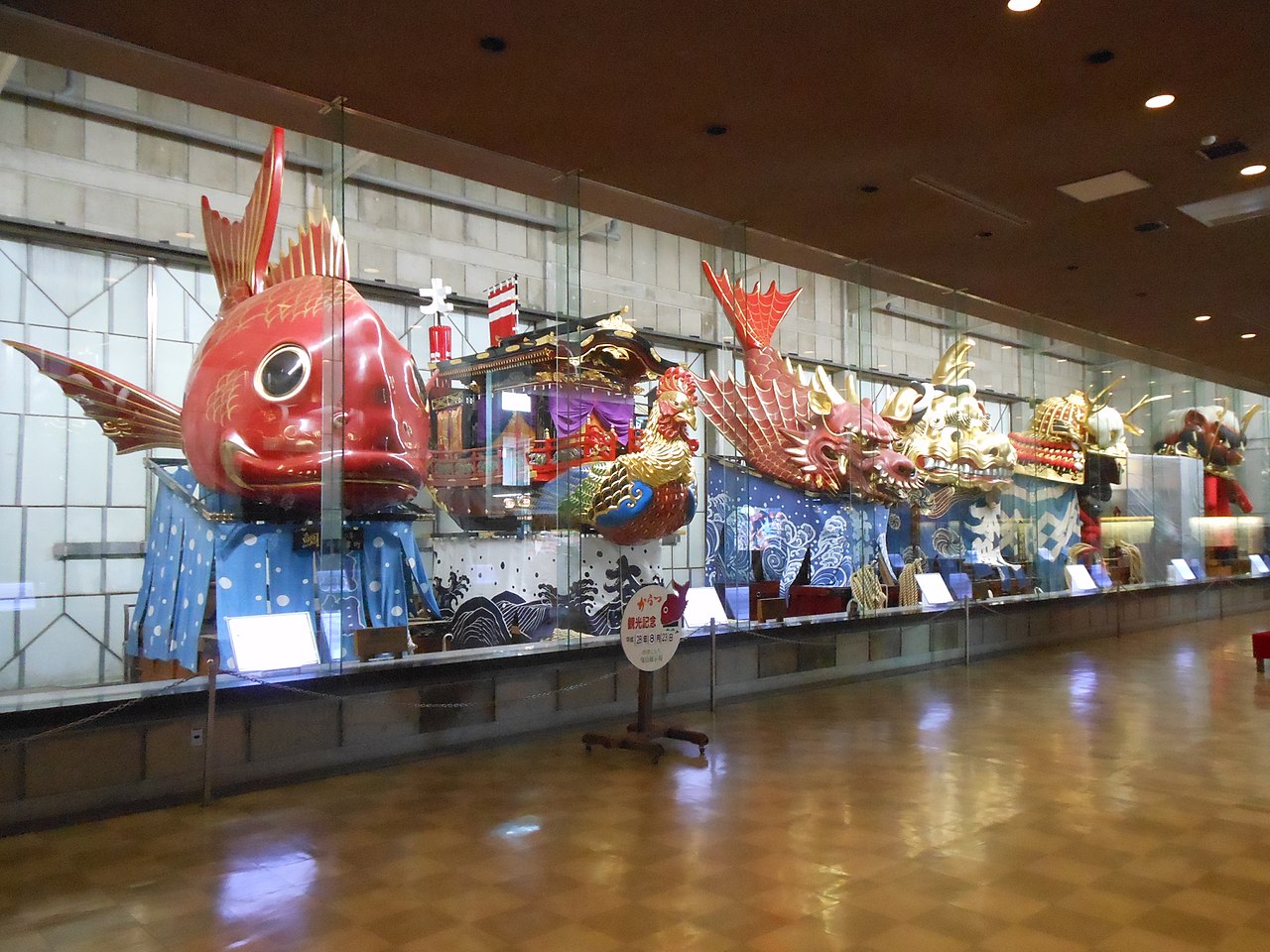
Each float has a different shape, including lions, samurai helmets, a turtle and a sea bream, and they are finished in washi paper, lacquer and gold leaf. The city calls them some of the largest dry-lacquer artworks in the world. Builders layer 100 to 200 sheets of washi to a thickness of 1 to 3 cm, and a float took 3 to 6 years to make.
The story behind them is a neighborhood rivalry. In 1819 the Katana-machi district finished the Red Lion, a giant lacquered lion head with musicians riding on its cart. The other districts were amazed, and they kept building new floats until 1876; 14 floats from 14 districts survive today. Even the music is competitive: the seri-bayashi tune is said to express the townspeople's spirit toward the samurai, and each district plays it so differently that you can tell which one is coming just by the sound.

The procession is a national Important Intangible Folk Cultural Property and has been on UNESCO's Intangible Cultural Heritage list since December 2016.
Where to watch and the crowd rules
For drama, choose the Nishinohama sand pull on November 3; for atmosphere, choose the lantern-lit evening of November 2. Temporary information booths stand beside Higobori (east of City Hall) on all three days, and at the Otabisho (former Taisei Elementary School) on November 3.

The official rules are strict, and police and float staff enforce them:
- Do not sit on the road to watch, and do not use selfie sticks.
- Do not walk alongside or right behind a float; it gets in the way of steering.
- Do not lean out from the sidewalk; haulers run across the full width of the road.
- Leave corners wide open, because they are the most dangerous spots.
- Drones are banned over the route and around Karatsu Shrine.
Getting to Karatsu from Fukuoka (and getting back)
Getting there: the city asks visitors to use public transport. If you drive, the temporary free parking lots open only 17:00–22:30 on November 2 and 9:00–17:00 on November 3 and 4. Cars cannot enter or leave outside those hours, and there are no shuttle buses to the route.
Pay correctly: IC transit cards cannot be used on the JR Karatsu Line (Karatsu–Kubota) or on the JR Chikuhi Line between Yamamoto and Imari, so buy paper tickets on those sections. On the Fukuoka City Subway, credit card tap payment is not accepted, so use an IC card there.
Getting back: the November 2 procession runs until 21:30, and the last floats arrive about 50 minutes after float No. 1. If you are staying in Fukuoka, check the last train back on the JR Kyushu timetable before the procession starts, and walk to the station before the final float passes.
Where to stay: book a room in Karatsu as early as you can, or use Fukuoka as a fallback base; see our Kyushu Recovery Discount guide to check whether your stay qualifies.
Practical tips for Karatsu Kunchi
- Arrive early for the 12:00 sand pull on November 3 and claim a spot away from the corners.
- Arriving on November 1? Each district practices its music every evening from around 19:00, every day from October 1 until the festival.
- Questions during the festival: Karatsu Station Tourist Information, tel. 0955-72-4963.
- Pack a light, water and layers; our festival-day checklist covers the rest.
Before or after the festival
Missed the floats? You can still see them up close at the Hikiyama Exhibition Hall in the Arpino building next to Karatsu Station: open 9:00–17:00, adults ¥310, elementary and junior high students ¥150, closed December 29–31. The next chance to see all 14 together outside Kunchi is the spring festival on April 29, 10:00–15:00, in front of Karatsu Shrine (cancelled in rain).
With a spare day, Karatsu Castle, the Nijinomatsubara pine grove and the Yobuko morning market are good add-ons; check their opening times before you go.

Planning the next one? Browse the Japan festival calendar, and check the Tenjin crowd forecast if you are basing yourself in Fukuoka.
Places in this article: how crowded are they now?
Hour-by-hour estimates (LEVEL 1–5). Tap a place to see today’s calmest times.
See all crowd estimates
Sources
Facts in this article were checked against these official sources.
Photo credits
Photo: Pekachu · CC BY-SA 4.0
Comments
Anyone can comment with just a nickname. Comments with links or contact details are published after review.
Loading comments…