Shichi-Go-San Meaning: Why Kids Visit Shrines, and Chitose Ame Candy
 Written by Mei · IKOKA Japan
Shichi-Go-San meaning explained: why kids aged 3, 5 and 7 visit shrines in November, what chitose ame candy means, and photo etiquette at Meiji Jingu.

Walk into a Japanese shrine on a weekend in mid-November and you may share the gravel path with tiny children in kimono, a five-year-old in stiff hakama trousers, and a long paper bag of candy swinging from a small hand. This is Shichi-Go-San, and the Shichi-Go-San meaning is simpler and more moving than the photos suggest: families are giving thanks that their child has made it this far.
Shichi-Go-San literally means "seven-five-three." Here is what each age stands for, why the date is November 15, what that long candy is, and how to enjoy the scene at a shrine like Meiji Jingu without getting in anyone's way.
Shichi-Go-San meaning: thanks for growing up safely
According to Meiji Jingu, Shichi-Go-San is the custom of visiting a nearby shrine at the milestones of three, five and seven to give thanks that a child has grown up safely and to pray for future happiness and a long life. It began as an event of the imperial court and court nobles before spreading widely.

The reason behind it is sobering. In the days when many infants did not survive, children up to the age of seven were regarded as "children of the gods," and only at seven were they recognized as members of society. Kanda Myojin, known as the guardian shrine of old Edo (Tokyo), cites the old saying "until seven, children are among the gods" (nanatsu made wa kami no uchi): only after seven did a child take a first step as a full member of society. Hakozakigu, a major shrine in Fukuoka, adds the plain reason: many children once died young of illness, so growing up year by year was never taken for granted.
Seen that way, the bright kimono and family photos celebrate something that was once never guaranteed.
Shichi-Go-San history: from court nobles to Edo townspeople
Meiji Jingu traces the roots to the mid-Heian period, when court nobles held celebrations for boys and girls between three and seven or eight. Shrine visits like today's date from the Edo period and were most common in the Kanto region around Edo, much less so in Kansai. The National Diet Library describes how these rites, held in samurai society, spread to townspeople by the late Edo period, when boys at three and five and girls at three and seven visited shrines.
The name itself is younger than the custom. Meiji Jingu notes that the word "Shichi-Go-San" came into use in the Meiji era, with an 1878 newspaper article already mentioning it, and that today's lively crowds date from the Taisho era. Kimono merchants played a part too: once they began selling children's goods for the occasion, the shrine visits became far more popular. In the Edo period, Kanda Myojin notes, people did not even say "Shichi-Go-San"; they spoke of the kamioki, hakamagi and obitoki celebrations, or iwaigo-mode (celebration visits).
Why November 15?
The most quoted story involves the fifth shogun. Hakozakigu says Tokugawa Tsunayoshi's son Tokumatsu held his kamioki celebration on November 15, 1681, and that this is said to be why the day became the date of celebration. Meiji Jingu adds other explanations: the day was considered kijukunichi, the most auspicious day, and it was also the day of the Shimotsuki (eleventh-month) festival.
The three ages: what 3, 5 and 7 stand for
Each age was once its own ceremony. Hakozakigu explains them this way: kamioki was for both boys and girls, who from that day began growing out hair that had been shaved until then; hakamagi marked a five-year-old boy's first hakama; and at obitoki a seven-year-old girl moved from a kimono held with tie cords to one fastened with an obi.
| Age | Who (today) | Old ceremony | What it marked | Typical outfit |
|---|---|---|---|---|
| 3 | Girls (boys too in some areas) | Kamioki | Starting to grow the hair out | Festive kimono without an obi, with a sleeveless vermilion hifu vest |
| 5 | Boys | Hakamagi | First hakama trousers | Crested kimono with haori and hakama, a white fan and a mamori-gatana (protective sword) |
| 7 | Girls | Obitoki | Swapping children's tie cords for an adult obi | Yuzen-patterned kimono tied with a maru-obi |
The ages and outfits in this table follow Meiji Jingu's Shichi-Go-San Q&A and Hakozakigu's explanation.

Traditionally the ages were counted in kazoedoshi, the old system in which a baby is one at birth: boys at three and five, girls at three and seven. Today most families use actual age, with boys at five (three in some regions) and girls at three and seven, and Meiji Jingu says siblings can even celebrate together.

Chitose ame: the thousand-year candy
That long bag in a child's hand holds chitose ame, long sticks of candy whose name means "a thousand years." Tokyo confectioner Eitaro, which supplies it to shrines, decorates its long bags with cranes and turtles, both symbols of long life. Kanda Myojin hands chitose ame to children who come for their Shichi-Go-San visit, along with a Shichi-Go-San amulet, and says the candy originated at the shrine.

Where did it really start? Eitaro says there are several theories. One credits Shichibei, a candy seller in Asakusa in the Genroku-Hoei era (1688-1711), who named his candy sennen-ame ("thousand-year candy") or jumyoto ("long-life sugar"). Another says Hirano Kuro Shigemasa made candy in Hirano, Osaka, then moved to Edo and sold it as chitose ame in the grounds of Senso-ji. Either way, it was first sold at shrine gates for babies' first shrine visits, which earned it the name miyamairi-ame, before it became the Shichi-Go-San staple it is today.
So if you see a child nibbling one on the shrine path, it is more than a treat: it is a wish wrapped in paper.
Where to see Shichi-Go-San: Meiji Jingu and beyond
Meiji Jingu in Shibuya lists Shichi-Go-San among its rites of life, held on or around November 15 to pray for children's healthy growth. There is no admission fee, and visiting the shrine itself takes around an hour. The gates open at sunrise and close at sunset, so hours change by month.

Do not plan only around the 15th. Hakozakigu says visits are now spread from October to the end of November, with the Saturdays and Sundays around November 15 the busiest. In Tokyo, Kanda Myojin accepts Shichi-Go-San prayers at any time during November, without reservations, from 9 a.m. to 4 p.m.
Want to avoid the busiest hour at Meiji Jingu? Check the live crowd level before you go:
This short video from Hakusan Shrine in Niigata shows how a Shichi-Go-San day flows at a shrine, from arrival to prayer:
Shrine etiquette for travelers during Shichi-Go-San
These are family milestones, so a little care goes a long way. Meiji Jingu's own rules are clear:
- No photos or videos at the main sanctuary, where people pray. The shrine also asks visitors not to photograph the amulet office.
- No drones, and eating, drinking or smoking only in designated areas.
- To pray, bow twice, clap twice, then bow once more.
- The shrine asks visitors not to hire professional photographers for commemorative photos.

Our own suggestion: if a child in kimono catches your eye, ask the parents before taking a photo, keep to the side of the path, and let families with small children go first at the purification fountain. A smile and a quiet "omedetou gozaimasu" (congratulations) is always welcome.
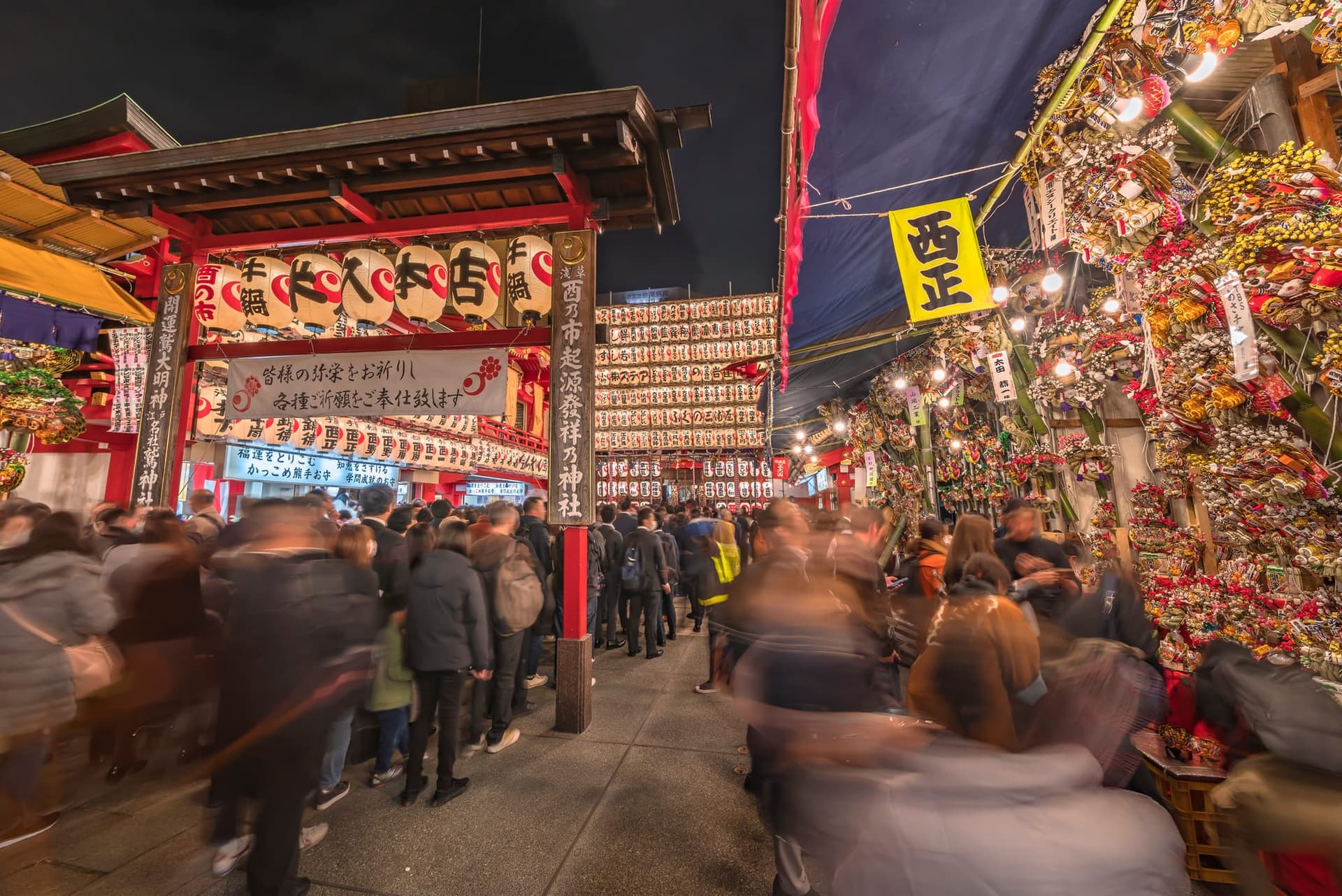
Shichi-Go-San falls in the same weeks as Tokyo's Tori no Ichi fairs and other November festivals, so it is easy to build a shrine day around it.
Have you ever seen a Shichi-Go-San family at a shrine, or does your country have a similar celebration for children?
Places in this article: how crowded are they now?
Hour-by-hour estimates (LEVEL 1–5). Tap a place to see today’s calmest times.
 Meiji JinguTokyo · Shrine & templeQuieter at 16:00 · 17:00Crowd LEVEL 2/5 · Calm (estimate)
 Shibuya CrossingTokyo · SightseeingQuieter at 10:00 · 21:00Crowd LEVEL 2/5 · Calm (estimate)
 Senso-ji, AsakusaTokyo · Shrine & templeQuieter at 16:00 · 17:00Crowd LEVEL 3/5 · Moderate (estimate)
Sources
Facts in this article were checked against these official sources.
- 筥崎宮 Hakozakigu (official)
- 榮太樓 Eitaro
- 神田明神
- Meiji Jingu (official, Etiquette)
- Meiji Jingu (official, Rites of life)
- Meiji Jingu (official, Q&A)
- 明治神宮 Meiji Jingu (official, Shinto FAQ)
- 明治神宮 Meiji Jingu (official, prayer FAQ)
- 明治神宮 Meiji Jingu (official, visitor guide)
- 国立国会図書館 National Diet Library (NDL Image Bank)
Photo credits
Photo: IKOKA · shutterstock shutterstock-unlimited
Comments
Anyone can comment with just a nickname. Comments with links or contact details are published after review.
Loading comments…